Advanced examples
The examples below show how to feed your own precomputed cosmological quantities, or use a mask (or even two different masks) to compute the SSC in partial sky
Import modules
[1]:
import math ; pi=math.pi
import numpy as np
import matplotlib
import matplotlib.pyplot as plt
%matplotlib inline
matplotlib.rcParams['mathtext.fontset'] = 'stix'
matplotlib.rcParams['font.family'] = 'STIXGeneral'
import time
[2]:
# Import PySSC module
import PySSC
Preliminary: Gaussian kernels
[3]:
# Define redshift range
nz    = 500
z_arr = np.linspace(0,2,num=nz+1)[1:] # Redshifts must be > 0
zmin  = z_arr.min() ; zmax = z_arr.max()
[4]:
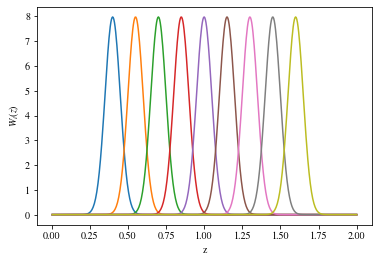
sigmaz    = 0.05
zcenter_G = [0.4,0.55,0.7,0.85,1.,1.15,1.3,1.45,1.6]
nbins_G   = len(zcenter_G)
kernels_G = np.zeros((nbins_G,nz))
for i in range(nbins_G):
    kernels_G[i,:] = np.exp(-(z_arr-zcenter_G[i])**2/(2*sigmaz**2)) / np.sqrt(2*pi*sigmaz**2)
[5]:
# Plot kernels
for i in range(nbins_G):
    plt.plot(z_arr,kernels_G[i,:])
plt.xlabel('z') ; plt.ylabel('$W_i(z)$')
plt.show()
Compute \(\sigma^2(z_1,z_2)\)
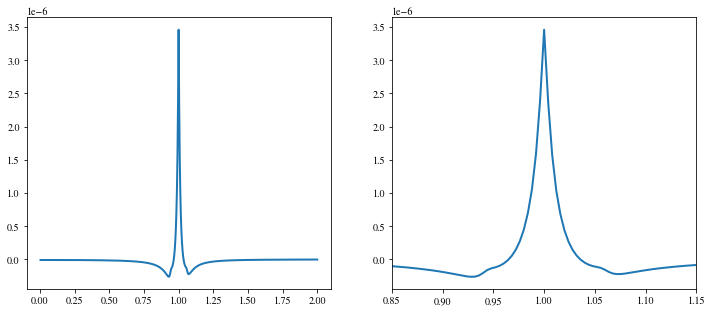
\(\sigma^2(z_1,z_2) = \frac{1}{2\pi^2} \int k^2 dk \, P(k|z_1,z_2) \ j_0(k r_1) \, j_0(k r_2)\) is the (fullsky) covariance between the background shifts in infinitesimal redshift bins, i.e. \(<\delta_b(z_1) \, \delta_b(z_2)>\). It can also be seen as the limit of Sij for infinitesimal bins.
[24]:
#Compute sigma2
t0 = time.process_time()
sigma2_fullsky = PySSC.sigma2_fullsky(z_arr)
t1 = time.process_time()
print(t1-t0)
8.013898887000039
[25]:
#Plot it
iz_sel = 249 ; print(z_arr[iz_sel])
fig = plt.figure(figsize=(12,5))
#All redshifts
plt.subplot(1,2,1)
plt.plot(z_arr,sigma2_fullsky[:,iz_sel],linewidth=2)
#zoom-in on peak
plt.subplot(1,2,2)
plt.plot(z_arr,sigma2_fullsky[:,iz_sel],linewidth=2)
plt.xlim([0.85,1.15])
plt.show()
1.0
Use your own cosmology
Say you do not want PySSC to recompute (with CLASS) the cosmology : comoving distances, P(k) etc.
For instance because you have already computed it, you study a non-standard model that is not supported by CLASS, or any other reason.
Then you can input this cosmology to PySSC by creating an object with the same keys as the CLASS objects, and pass it to PySSC routines.
In detail, if the object is called cosmo, the necessary keys are: - cosmo.h giving the hubble factor - cosmo.z_of_r giving the comoving distance (in Mpc) and its derivative w.r.t. redshift - cosmo.pk(k,z) giving the (linear) matter power spectrum in Mpc^3 - cosmo.scale_independent_growth_factor(z) giving the linear growth factor
The format of these objects should be identical to the one of CLASS.
Example:
Let’s precompute the cosmo with CLASS ourselves and feed it to PySSC
[6]:
from classy import Class
[7]:
#Precompute the cosmo
params = {'omega_b':0.022,'omega_cdm':0.12,'H0':67.,'n_s':0.96,'sigma8':0.81}
cosmo = Class()
dico4Class = params
dico4Class['output'] = 'mPk'
cosmo.set(dico4Class)
cosmo.compute()
[8]:
#Feed it to PySSC: use the optional parameter cosmo_Class
t0 = time.process_time()
Sij_precomp = PySSC.Sij(z_arr,kernels_G,cosmo_Class=cosmo)
t1 = time.process_time()
print(t1-t0)
0.8317237660000005
[9]:
#Compute the same matrix the standard way
t0 = time.process_time()
Sij_std = PySSC.Sij(z_arr,kernels_G,cosmo_params=params)
t1 = time.process_time()
print(t1-t0)
2.5067992079999994
[10]:
#Check the difference
diff = Sij_precomp - Sij_std
print(diff.min(),diff.max())
0.0 0.0
Use a mask
[11]:
# Mask files
masks_path   = './masks/'
mask_fullsky = masks_path+'full_sky_map.fits'
mask_DES     = masks_path+'DES-mask-simple-ring-1024.fits'
[12]:
# Mask power spectra
import healpy as hp
# full sky
map_fullsky    = hp.read_map(str(mask_fullsky), dtype=np.float64, verbose=False)
nside_fullsky  = hp.pixelfunc.get_nside(map_fullsky) ; lmax_fullsky = 2*nside_fullsky
Cl_fullsky     = hp.anafast(map_fullsky, lmax=lmax_fullsky)
# DES
map_DES        = hp.read_map(str(mask_DES), dtype=np.float64, verbose=False)
nside_DES      = hp.pixelfunc.get_nside(map_DES) ; lmax_DES = 2*nside_DES
Cl_DES         = hp.anafast(map_DES, lmax=lmax_DES)
# DES x full sky
Cl_DES_fullsky = hp.anafast(map_DES, map2=map_fullsky,lmax=lmax_fullsky)
WARNING: AstropyDeprecationWarning: "verbose" was deprecated in version 1.15.0 and will be removed in a future version.  [warnings]
WARNING: AstropyDeprecationWarning: "verbose" was deprecated in version 1.15.0 and will be removed in a future version.  [warnings]
Mask=full sky, for comparison with previous routine
[13]:
# Compute Sij with fullsky routine and with partial sky routine fed a fullsky mask
t0 = time.process_time()
Sij_full = PySSC.Sij(z_arr,kernels_G)
t1 = time.process_time()
Sij_psky = PySSC.Sij_psky(z_arr,kernels_G,clmask=Cl_fullsky)
t2 = time.process_time()
print('Sij full sky took: %.1f secs, partial sky %.1f secs' %(t1-t0,t2-t1))
Sij full sky took: 1.7 secs, partial sky 1.5 secs
[14]:
#Compare
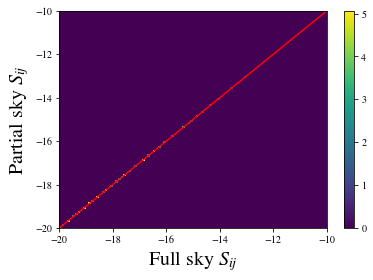
plt.figure()
plt.hist2d(np.log(abs(Sij_full)).flatten(),np.log(abs(Sij_psky)).flatten(),bins=100,density=True,range=[[-20,-10],[-20,-10]])
plt.plot(np.linspace(-20,-10,100),np.linspace(-20,-10,100),color='r')
plt.xlabel(r'Full sky $S_{ij}$',fontsize=20)
plt.ylabel(r'Partial sky $S_{ij}$',fontsize=20)
plt.colorbar()
diff = (np.log(abs(Sij_full)) - np.log(abs(Sij_psky)))/np.log(abs(Sij_psky)) *100
print('%.1f%% of the part sky Sij bins are within 1%% of the Sij full sky value' %(np.sum(diff<=1.)/nbins_G**2 *100))
100.0% of the part sky Sij bins are within 1% of the Sij full sky value
[15]:
# Remark: feeding the entire mask instead of its Cl is slower, because PySSC needs to read the mask and compute its Cl
t0 = time.process_time()
Sij_cl = PySSC.Sij_psky(z_arr,kernels_G,clmask=Cl_fullsky)
t1 = time.process_time()
Sij_mask = PySSC.Sij_psky(z_arr,kernels_G,mask=mask_fullsky)
t2 = time.process_time()
print('With Cl as input: %.1f secs. With mask file as input: %.1f secs' %(t1-t0,t2-t1))
With Cl as input: 1.5 secs. With mask file as input: 66.6 secs
Remark 2: the Cl or the mask can be fed either as numpy array or as fits file in Healpix format
DES-like mask
[16]:
t0 = time.process_time()
Sij_DES = PySSC.Sij_psky(z_arr,kernels_G,clmask=Cl_DES)
t1 = time.process_time()
print('Computed in %.1f secs' %(t1-t0))
Computed in 27.5 secs
[17]:
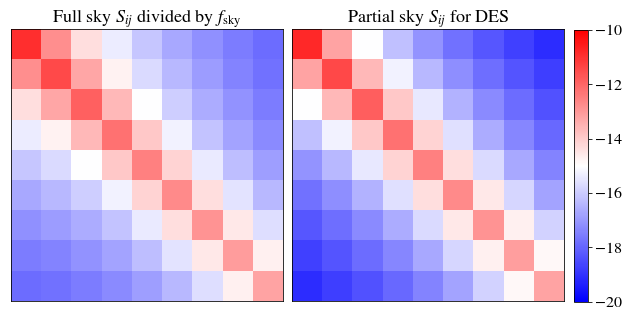
# Plot the DES matrix and compare with fullsky rescaled by sky fraction
f_sky = 0.1207
fig,axes = plt.subplots(1,2,figsize=(10,5),gridspec_kw={'wspace':0.02})
im  = axes[0].imshow(np.log(abs(Sij_full/f_sky)),interpolation='none',cmap='bwr',extent=[zmin,zmax,zmax,zmin],vmin=-20,vmax=-10)
im2 = axes[1].imshow(np.log(abs(Sij_DES)),interpolation='none',cmap='bwr',extent=[zmin,zmax,zmax,zmin],vmin=-20,vmax=-10)
axes[0].set_title('Full sky $S_{ij}$ divided by $f_\mathrm{sky}$',fontsize=18)
axes[1].set_title('Partial sky $S_{ij}$ for DES',fontsize=18)
for ax in axes:
    ax.get_xaxis().set_ticks([]) ; ax.get_yaxis().set_ticks([])
cbar_ax = fig.add_axes([0.91, 0.124, 0.02, 0.755])
c_bar=fig.colorbar(im,cax=cbar_ax,fraction=1)
c_bar.ax.tick_params(labelsize=16)

print('Mean relative difference: %.2f %%' %(np.mean(abs((np.log10(abs(Sij_full/f_sky))-np.log10(abs(Sij_DES)))/np.log10(abs(Sij_DES))*100))))
print('Mean relative difference on the diagonal: %.2f %%' %(np.mean(abs((np.log10(abs(np.diag(Sij_full)/f_sky))-np.log10(abs(np.diag(Sij_DES))))/np.log10(abs(np.diag(Sij_DES)))*100))))
Mean relative difference: 3.16 %
Mean relative difference on the diagonal: 0.27 %
cross DES x fullsky
[18]:
# Fastest is to compute by feeding the cross-spectrum of the two masks
t0 = time.process_time()
Sij_DESxfull = PySSC.Sij_psky(z_arr,kernels_G,clmask=Cl_DES_fullsky)
t1 = time.process_time()
print('Computed in %.1f secs' %(t1-t0))
Computed in 1.3 secs
[19]:
# Alternatively you can feed the two masks explicitely, it's just slower
t0 = time.process_time()
Sij_DESxfull_viamask = PySSC.Sij_psky(z_arr,kernels_G,mask=mask_DES,mask2=mask_fullsky)
t1 = time.process_time()
print('Computed in %.1f secs' %(t1-t0))
diffrel = (Sij_DESxfull_viamask-Sij_DESxfull)/Sij_DESxfull
print('Relative difference in the range:',diffrel.min(),diffrel.max())
Computed in 68.2 secs
Relative difference in the range: 0.0 0.0
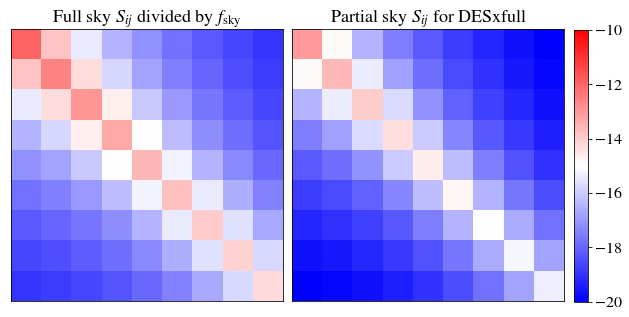
[20]:
# Plot the DES matrix and compare with fullsky rescaled by sky fraction
f_sky_cross = np.sqrt(0.1207)
fig,axes = plt.subplots(1,2,figsize=(10,5),gridspec_kw={'wspace':0.02})
im  = axes[0].imshow(np.log(abs(Sij_full/f_sky_cross)),interpolation='none',cmap='bwr',extent=[zmin,zmax,zmax,zmin],vmin=-20,vmax=-10)
im2 = axes[1].imshow(np.log(abs(Sij_DESxfull)),interpolation='none',cmap='bwr',extent=[zmin,zmax,zmax,zmin],vmin=-20,vmax=-10)
axes[0].set_title('Full sky $S_{ij}$ divided by $f_\mathrm{sky}$',fontsize=18)
axes[1].set_title('Partial sky $S_{ij}$ for DESxfull',fontsize=18)
for ax in axes:
    ax.get_xaxis().set_ticks([]) ; ax.get_yaxis().set_ticks([])
cbar_ax = fig.add_axes([0.91, 0.124, 0.02, 0.755])
c_bar=fig.colorbar(im,cax=cbar_ax,fraction=1)
c_bar.ax.tick_params(labelsize=16)

print('Mean relative difference: %.2f %%' %(np.mean(abs((np.log10(abs(Sij_full/f_sky_cross))-np.log10(abs(Sij_DESxfull)))/np.log10(abs(Sij_DESxfull))*100))))
print('Mean relative difference on the diagonal: %.2f %%' %(np.mean(abs((np.log10(abs(np.diag(Sij_full)/f_sky_cross))-np.log10(abs(np.diag(Sij_DESxfull))))/np.log10(abs(np.diag(Sij_DESxfull)))*100))))
Mean relative difference: 6.09 %
Mean relative difference on the diagonal: 7.34 %
[ ]: